
by Paul Boden & Western Regional Advocacy Project
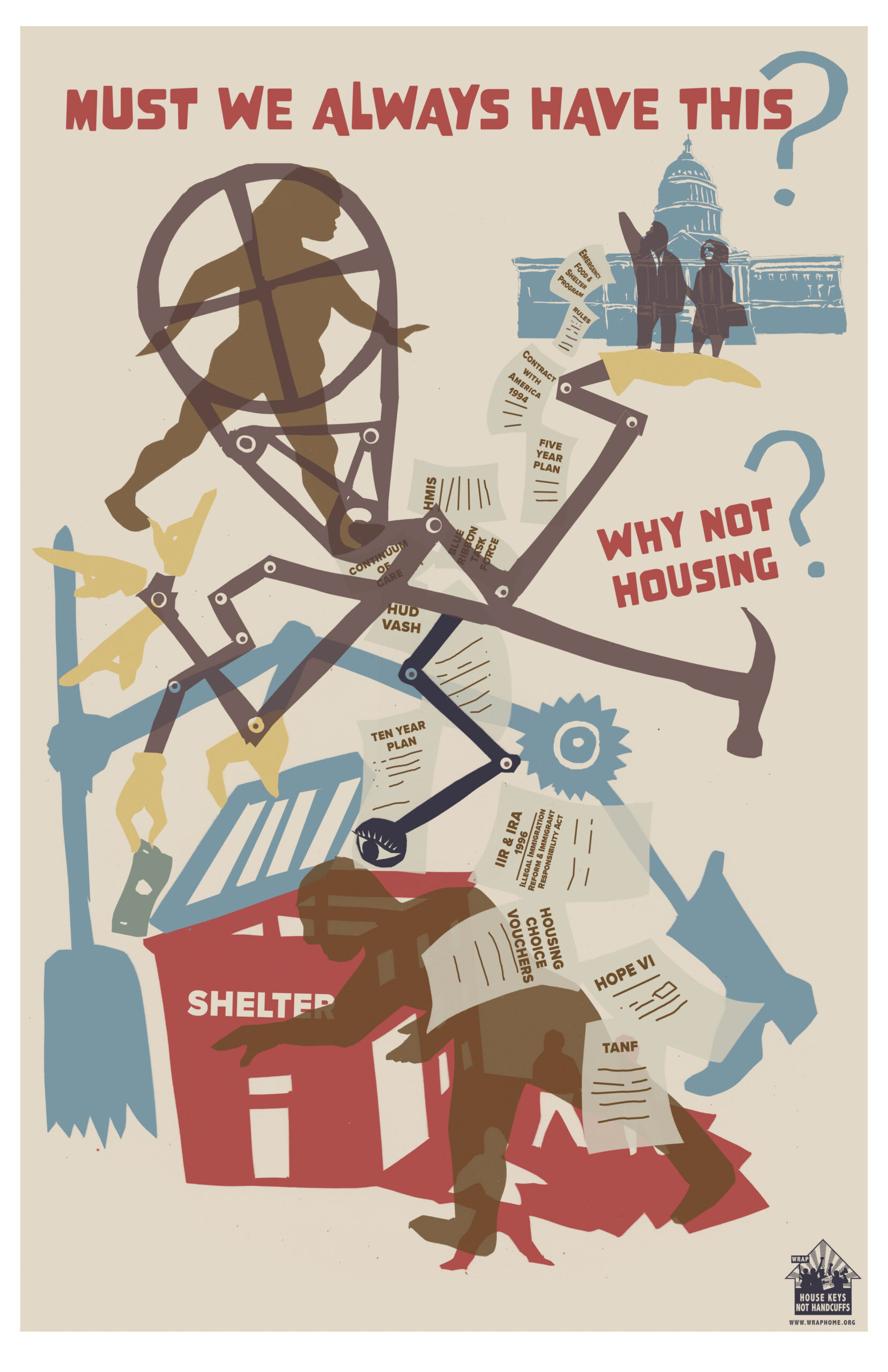
Forty years ago, the federal government slashed affordable housing budgets of the Department of Housing and Urban Development (HUD) and the United States Department of Agriculture (USDA), marking the beginning of the contemporary crisis of homelessness. It has become political fodder for local politicians to say they will end homelessness “in this city” with complete disregard for the fact that no one city created homelessness, and none will end it on their own.
To understand why national rates of homelessness skyrocketed in the 1980s, we must ask; what systemic factors changed in the late 1970s and early 1980s to allow so many people to fall through the social safety net and end up living and dying on our streets? What has been happening over the last 500 years to result in Black and Indigenous people being disproportionately represented in the houseless population, and hit hardest by criminalization? Homelessness is a direct result of the decisions and funding priorities of the federal government, in a larger context of white supremacy, settler colonialism and neoliberalism. If the federal government had chosen to support affordable housing, health care, anti-poverty wages and programs, worker’s protections, and quality education—rather than war, tax breaks for the wealthy, and corporate welfare—mass homelessness would not exist in our nation.
In 1983, the Reagan administration tasked the Federal Emergency Management Agency (FEMA) with directing a national solution to the rising number of people without homes. FEMA, the federal agency responsible for disaster relief, did what they always do, which was to create thousands of short-term, emergency shelters. Given the economic downturn of the 1980s, popular sentiment was that the crisis would self-correct in time. But by 1987, the passage of the McKinney-Vento Homeless Assistance Act marked the first federal legislation devoted solely to “managing” the epidemic of homelessness that was growing across the nation. As real affordable housing programs were being defunded by the federal government, funding for shelter programs grew exponentially. For four decades, homeless shelters that were meant to be a temporary solution to a temporary problem remain the primary response, along with criminalization, to people sleeping en masse in the streets. This ain’t no temporary problem and the Federal Government never honestly thought it would be.
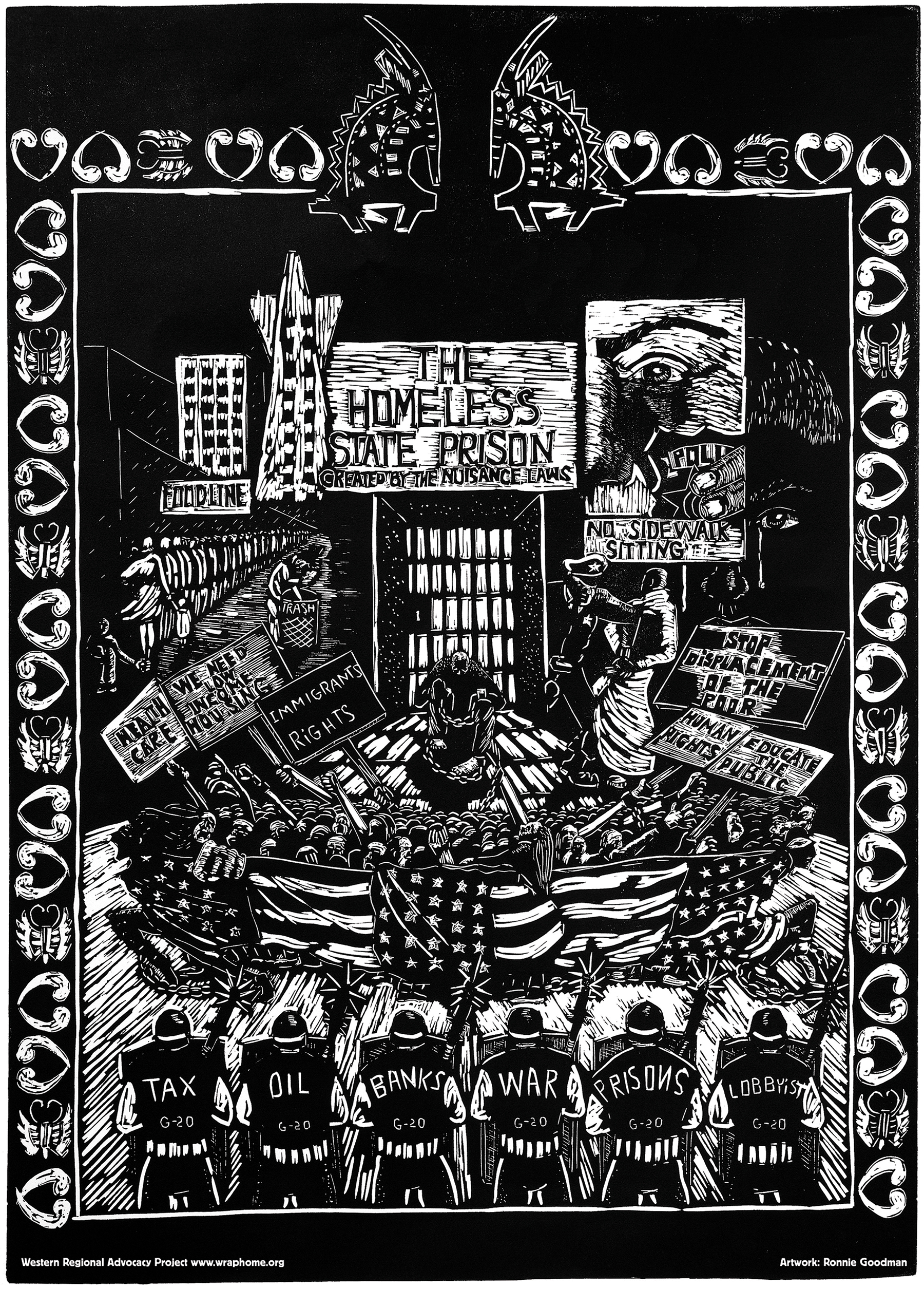
Historical context is critical to understanding who is hardest hit by forty years of social disinvestment. Ongoing systems of white supremacy and settler colonialism that affect everything from housing to healthcare, education to transportation, and especially the criminal (in)justice system mean that homelessness and its myriad related traumas disproportionately impact people along intersectional lines of race, gender, sexuality, disability, immigration, and so on. This is no accident.
It is exactly across these intersectional lines of difference that so many of us have joined forces in working for meaningful and deep change, building on ongoing fights for prison abolition, racial justice, disability justice, and countless other struggles. In 2005, for example, several groups organizing in the western US came together to create the Western Regional Advocacy Project (WRAP),and across the country other community groups are doing the same thing all fighting to give life to the realities of people with firsthand experience of these oppressive systems and to push for dignified solutions. We are continuing the fight to combat carceral shelters, end the criminalization of racialized poverty, stop the sweeps, and fight for actual housing, healthcare, education and dignity that all human beings deserve. True community organizing brings allied local groups together to find common threads and strategize paths forward, mobilize legal resources for members, creates artwork and shared messaging, connects communities through coordinated direct actions, research and so much more. Seek out these groups and expand the Human Rights framework of dignity and respect for people is not a charity issue, it is the least we should demand and expect of our government.
After 40 years, the system is still doing exactly what it was designed to do: manage and minimize the presence of homeless people. It was NEVER intended to address homelessness in any real way. I was here 40 years ago, and I’m still here today. The bunk beds and crash pads that FEMA funded was implemented to create a new category of housing status for members of a community but thats exactly what it has done. After 40 years of inhumane abject failure it is past time to recognize “managing visible homelessness” isn’t a solution to shit. Homelessness is just a more visible manifestation of a society lacking in justice.
Our organizing and public education most continue to build on the realities of all oppressed people so we lift our realities and our power together!
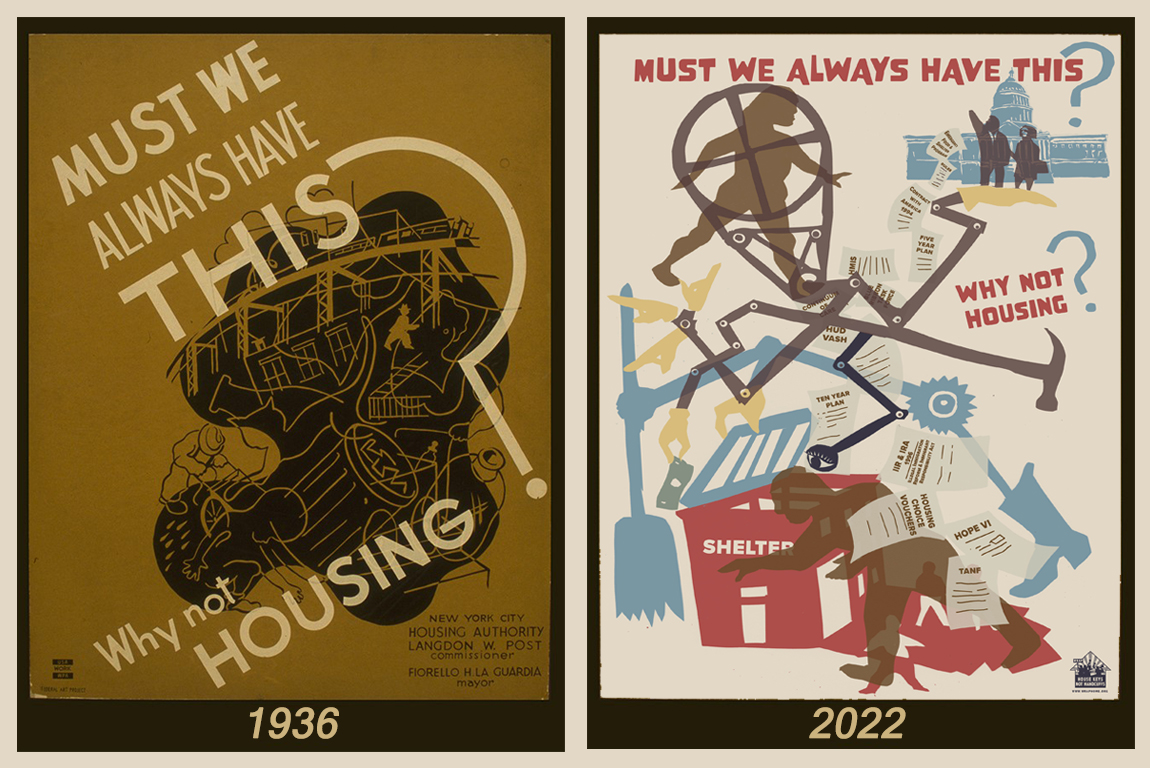
Federal Public Housing Administration created 1937
(Right) Art Hazelwood and WRAP 2022
Overthrow of neoliberal governance – freaking soon

Leave a Reply
You must be logged in to post a comment.