• Skip to primary navigation
  • Skip to main content
  • Skip to footer
WRAP

WRAP

Western Regional Advocacy Project

  • Donate Now
  • Get Email Updates
  • Contact Us
  • Home
  • About
    • 20 Years of Unhoused People Fighting for Dignity + Respect
    • 40 Years of Fighting
    • History
    • Mission
    • Strategy
    • Members
  • Campaigns
    • Business Improvement Districts
    • House Keys Not Sweeps
      • TARGETED, BANISHED, DISPLACED & SWEPT
    • Legal Defense Clinics Project
    • Homeless Bill of Rights
    • Without Housing
    • Street Outreach
  • Organizing Tools
    • Without Housing Organizing Toolkit
    • Homeless Bill of Rights Campaign Manual
    • WRAP Organizers Manual
    • WRAP Artwork
  • Resources
    • Pipe Dreams and Picket Fences Report
    • Art in Action Power Point Slide Show
    • Hobos to Street People
    • House Keys Book
    • Political Education
    • Legal Research
  • Media
    • Newsletters
    • Blog
    • Hobos to Street People Art Show
    • Street Newspapers
    • Sweeps Gallery Videos
    • Videos
  • Support Us
    • Donate
    • Become a Monthly Sustainer
    • Volunteer
    • Support WRAP
    • WRAP Newsletters & Updates Sign Up

40 AŇOS DE FALTA DE VIVIENDA

por Paul Boden y Western Regional Advocacy Project
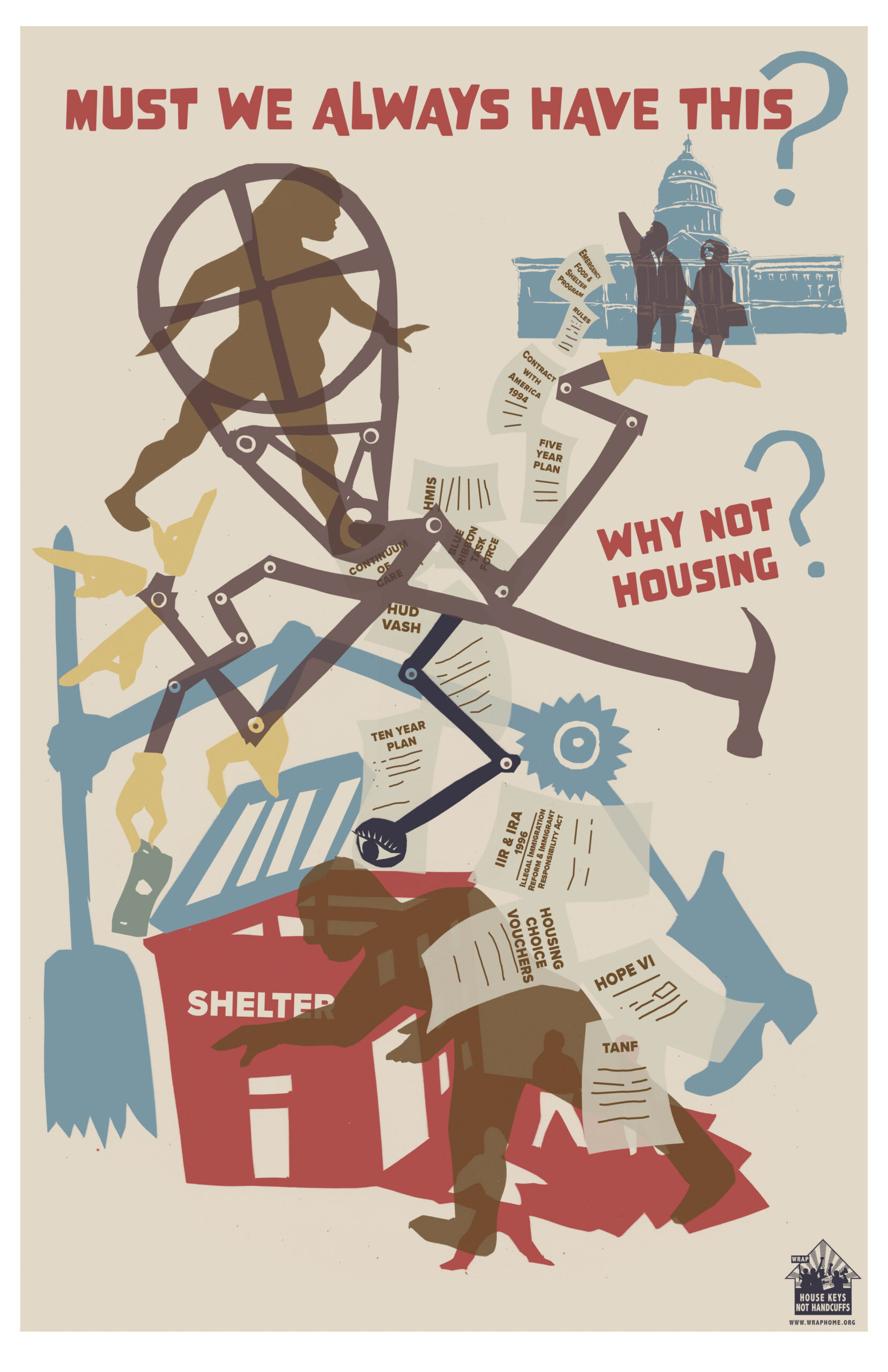
Art Hazelwood (WRAP Ministro de Cultura)

Hace cuarenta años, el gobierno federal corto drásticamente los presupuestos de vivienda publica del Departamento de Vivienda y Desarrollo Urbano (HUD) y el Departamento de Agricultura de los Estados Unidos (USDA), el cual marcó el comienzo de la crisis contemporánea de la falta de vivienda publica. Se ha puesto en pasto político que los políticos locales digan que van a poner fin a la falta de vivienda “en esta ciudad” con indiferencia total por el hecho que ninguna ciudad creó la falta de vivienda, y ninguna puede poner fin a la crisis por sí sola.

Para entender por qué los numeros de personas sin vivienda se dispararon en los años 80, tenemos que preguntar: ¿que factores sistémicos cambiaron a finales de la década de 1970 y a principios de la década de 1980 para dejar que tanta gente caigan a través de la red de seguridad social y terminar viviendo y muriendo en nuestras calles? ¿Qué ha pasado durante los últimos 500 años para resultar en que la gente negra e indigena sea representadas desproporcionadamente en la población sin vivienda, y más afectadas por la criminalización?

La falta de vivienda es un resultado directo de las decisiones y prioridades de financiación del gobierno federal, en un contexto más amplio de la supremacía blanca, el colonialismo de asentamiento, y neoliberalismo. Si el gobierno federal había apoyado vivienda asequible, salud de la gente, sueldos y programas contra la pobreza, protecciones para trabajadores, y educación de calidad—en vez de la guerra, exenciones fiscales para los más ricos, y asistencia pública para corporaciones—la falta de vivienda masiva no existiría en nuestro país.

En 1983, la administración de Reagan encargó a la Agencia Federal de Gestión de Emergencias (FEMA) la dirección de una solución nacional al aumento de personas sin vivienda. FEMA, la agencia federal que tiene responsabilidad para ayuda en casos de desastre, hizo lo que hacen siempre, que era crear miles de refugios de emergencia a corto plazo. Dado la recesión económica de los años de la década 1980, el sentimiento popular era que con el tiempo la crisis se autocorregiría. Pero para el año 1987, la aprobación del Acto de Asistencia para los sin Vivienda de McKinney-Vento marcó la primera legislación federal dedicada exclusivamente a “gestionar” la epidemia de falta de vivienda que crecía en toda la nación.
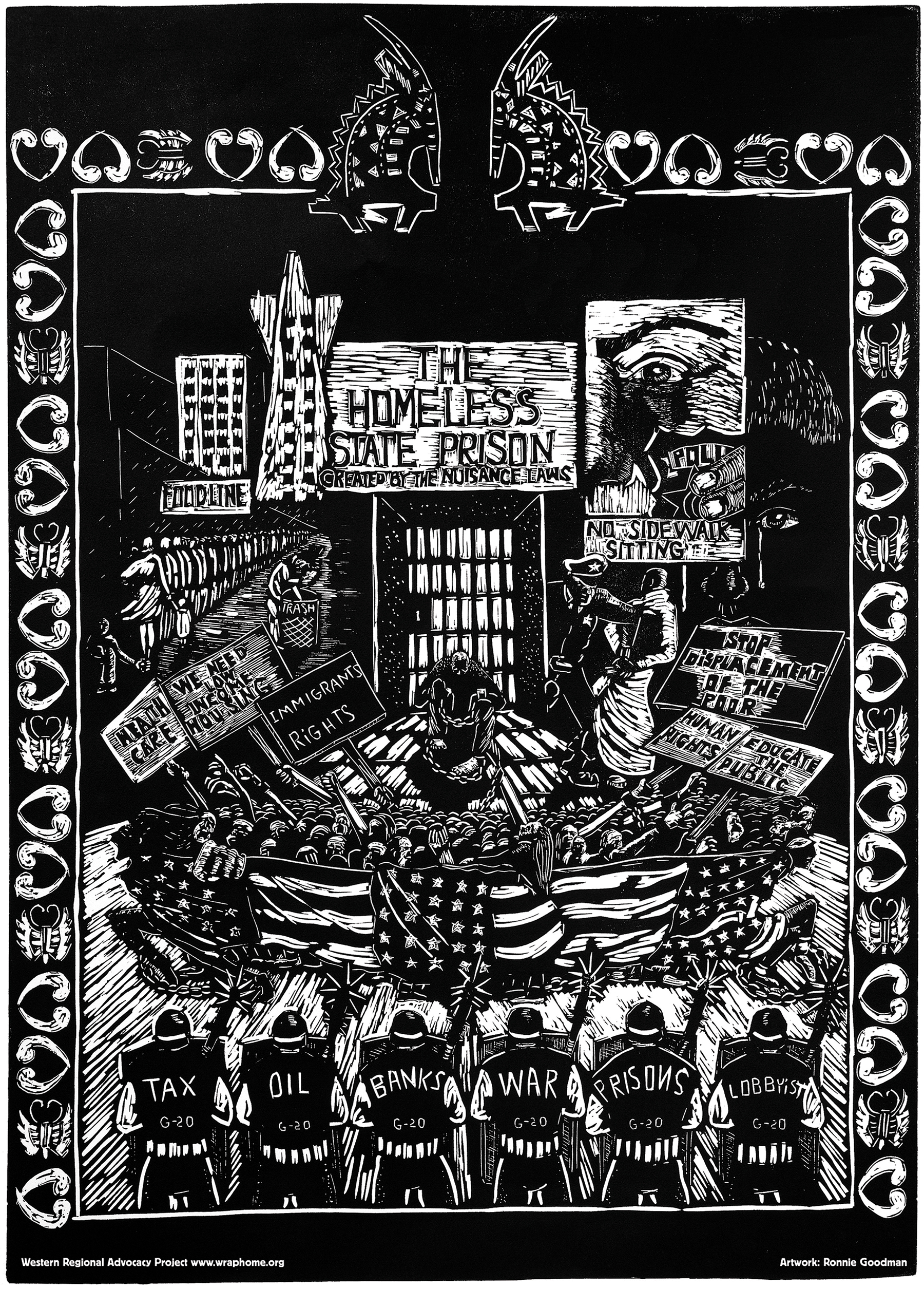
Ronnie Goodman, (2020) Rest in Power Brother

Mientras que el gobierno federal desfinanció verdaderos programas de vivienda publica, el financiamiento para programas de refugios aumentaron de manera exponencial. Durante cuatro décadas, los refugios para los sin vivienda que pretendieron ser una solución temporal a un problema temporal todavía representan la respuesta principal, junto con la criminalización, a que hay gente sin número durmiendo en las calles. Esto no es ningún problema temporal y el Gobierno Federal nunca creyó de verdad que lo sería.

El contexto histórico es fundamental para entender quiénes son los mas afectados por cuarenta años de desinversión social. Los sistemas constantes de la supremacía blanca y el colonialismo que afectan todo desde la vivienda publica a la atencion sanitaria, la educación al transporte, y especialmente el sistema de (in)justicia criminal significan que la falta de vivienda y las traumas innumerables relacionadas les afectan de manera desproporcionada a personas a lo largo de líneas interseccionales de la raza, el género, la sexualidad, la discapacidad, el estatus de inmigración, etcétera. Esto no es casual.

Es exactamente a través de estas líneas interseccionales de diferencia que tantos de nosotros nos hemos unido en trabajar hacia cambio significativo y profundo, basando en las luchas continuas para la abolición de las prisiones, la justicia racial, la justicia de discapacidades, y innumerables otras luchas. Por ejemplo, en 2005, varios grupos organizando en el oeste de EEUU se juntaron para crear el Western Regional Advocacy Project (WRAP), y por todo el pais otros grupos comunitarios hacen lo mismo, todos luchando para dar vida a las realidades de las personas con experiencia propia de estos sistemas opresivos y para propugnar soluciones dignas. Seguimos la lucha por la abolición de los refugios carcelarios, poner fin a la criminalización de la pobreza racializada, detener los desalojos de personas viviendo en las calles, y luchar para la vivienda publica, atención sanitaria, educación y dignidad verdadera que todos seres humanos merecen. Verdaderas organización comunitarias junta a los grupos locales para encontrar los hilos comunes y crear estrategias de un camino adelante, moviliza recursos legales para miembros, crea arte y mensajería común, conecta las comunidades a través de acciones directas coordinadas, investigación, y mucho más. Buscar estos grupos y expandir los Derechos Humanos el marco de dignidad y respeto para la gente no es un asunto de caridad, es lo menos que debemos demandar y esperar de nuestro gobierno.

Después de 40 años, el sistema continúa haciendo exactamente lo que se diseñó: dominar y minimizar la presencia de personas sin vivienda. NUNCA pretendía abordar la falta de vivienda de ninguna manera verdadera. Yo estuve aquí hace 40 años, y hoy todavía estoy aquí. Las camas literas y “crash pads” o hostales que financiaba FEMA no se implementó para crear una categoría de estatus de vivienda para miembros de una comunidad pero eso es exactamente lo que ha hecho. Después de 40 años de fracaso abyecto inhumano ya es tarde reconocer “dirigir la falta de vivienda visible” no es una solución para la mierda. La falta de vivienda es solamente una manifestación muy visible de una sociedad que carece de justicia.
Nuestra educación y capacitación del público tiene que continuar basándose en las realidades de toda gente oprimida para que levantemos nuestras realidades y nuestro poder juntos!
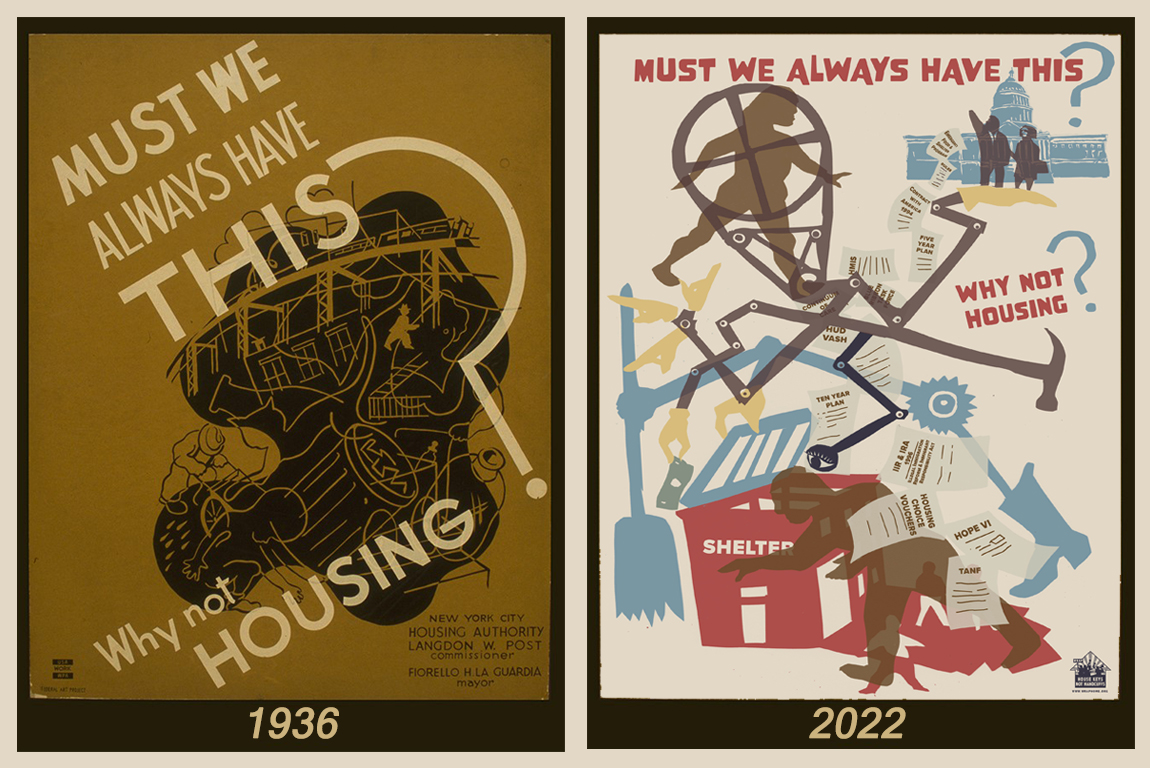
Izquierda) Mayor and Housing Director of NYC in 1936, arte pagado por WPA
Federal Public Housing Administration creado en 1937
 
(Derecha) Art Hazelwood and WRAP 2022
Overthrow of neoliberal governance – freaking soon

Footer

Instagram Feed

Every day we witness the criminalization of povert Every day we witness the criminalization of poverty and homelessness where local governments across the country unleash the force of the State against people forced to live in public space. Blaming unhoused people for the fact homelessness exists while they continue to ignore the devastation of public and affordable housing program for people.

Read our post to understand what sweeps are and how they’re used in the cycle of homelessness! #StopTheSweeps
San Francisco, CA. We have an abusive government! San Francisco, CA. We have an abusive government! Speak out against cuts to senior & disability programs! April 15 Join the board of supervisors' budget committee hearing to share your story! Meet at noon for an action. Hearing begins at 1:30pm Room 278
WRAP's birthday month is coming to a close in less WRAP's birthday month is coming to a close in less than 10 hours! Continue to support our work in the following ways: 

✨Help us raise $2,100 by the end of today! 
✨Grow our monthly donors by 21 people! 
✨Subscribe to our newsletter & stay updated about WRAP resources, WRAP members & articles on homeless policy! 

We want everyone to keep celebrating with us by building, strengthening, & broadening the movement to end the criminalization of poverty & homelessness! 

Reach out to WRAP today to learn more about volunteer opportunities, how to support our work & how to get connected with our members! 

Reach out to wrap@wraphome.org 

All WRAP member organizations are tagged & links can be found in our linktree.
As more people continue to get connected with the As more people continue to get connected with the Western Regional Advocacy Project (WRAP), we wanted to introduce ourselves to all of you. Check out this post to understand who we are! 

Founded in 2005, WRAP is an organization that unites local community organizing groups with the common aim of fighting against the root causes of poverty & homelessness. 

WRAP’s analysis of neoliberal policies expose the prioritization of profit and privatization of affordable housing over solving homelessness. This has resulted in the increase of homelessness & poverty across the country. Homelessness is an issue entrenched in the very fabric of federal cuts to affordable housing, ever changing policies and legislation. 

WRAP members are spread across 5 states: California, Colorado, Oregon, Montana, & Washington. Our members are local groups from both city and rural contexts. 
To keep WRAP accountable, our members drive our priorities by ensuring they’re grounded in the community. 

Our strategies have the power of collective mobilization & are intended to be utilized locally & nationally. We emphasize the importance of community organizing so all of our resources can be used by the public in their work! 

As an organization that is celebrating our 21st year as of March 2026, we are grateful for all the support and collaboration over the years! We know that the only way we win this fight is together so get connected with WRAP today & let’s continue to fight for our unhoused and poor neighbors! 

Ways to support WRAP 
✨Sign up for our newsletter where we share what our members are up to, WRAP resources, & policies & developments on homelessness.
✨Become a monthly donor or send in a one time donation. 
✨Reach out to wrap@wraphome.org to learn about volunteer opportunities. 
✨Reach out to any of our local member groups to begin organizing with them! 

*All links can be found in our linktree found in our bio!

@coalitiononhomelessness @housekeysactionnetworkdenver @humanrighttohousingcollective @judismidnightdiner @lacanetwork_official @loveandjusticeinthestreets @streetspiritnews @unumissoula
We’re going LIVE in a bit 🔴 21 years in, and stil We’re going LIVE in a bit 🔴

21 years in, and still organizing, still fighting the criminalization of poverty.

Tap in for REAL TALK with folks who’ve been doing this work for decades.

🕑 2p PT / 3p MT / 4p CT / 5p ET

instagram.com/@westernregionaladvocacyproject
🔈Tune in for "Real talk: Celebrating 21 Years of F 🔈Tune in for "Real talk: Celebrating 21 Years of Fighting the Criminalization of Poverty!" 

WHEN: Tuesday, March 24 
WHERE: IG LIVE (click the WRAP ig account to listen in!) 

Join us in a conversation between Paul (WRAP) & General Dogon from Los Angeles Community Action Network, who was one of WRAP's founding members, in celebrating 21 years of fighting the criminalization of poverty! 

These organizers will talk about the lessons garnered through decades of organizing and how can we continue to advance the struggle for poor and unhoused people. 

Can't make it? Follow WRAP & sign up for our newsletter to watch the recording and to stay in touch!
WRAP is celebrating 21 years of fighting alongside WRAP is celebrating 21 years of fighting alongside poor & unhoused people! 🎉

As we usher in our 21st year, we celebrate all the work of our WRAP members in California, Oregon, Washington, Montana & Colorado!

The work of WRAP relies on organizations & individuals who believe that in order to solve homelessness, we must eliminate & expose its root causes. 

We're celebrating our 21st bday all year long! Here's how YOU can celebrate with us! 

💰Help us raise $2,100 by the end of March! 

📬Grow our monthly donors by 21 by the end of the year. $5, $10, $20, $50 any amount is appreciated! 

✉️Subscribe to our monthly newsletter where we highlight the work of our members and share updates on homeless policy.

Share WRAP with your friends and family because fighting homelessness is going to take all of us! 

All links can be found in our linktree in our bio! 

linktr.ee/WesternRegionalAdvocacyProject
Repression Breeds Resistance: Honoring Community O Repression Breeds Resistance: Honoring Community Organizing

We must celebrate and honor that people remain steadfast in their commitment to organize as the US government has continued its mission of fascist dictatorial rule.
The tactics implemented by today’s American fascist dictatorship have long mirrored similar tyrannical tactics throughout history: “repression breeds resistance” is a relevant phrase now more than ever. 

Organizers across the country have demonstrated that this resistance can take many forms and that’s our strength and our beauty as we build community locally and across the country. 

Immigrants, queer & trans people, unhoused people, disabled people, people of color are the primary targets for oppression; however, under a fascist dictatorship, everyone becomes a target so long as you are advocating for basic human rights and not advancing the interests of the ruling class. Militarized police and immigration enforcement systems are created to protect fascists and their cronies from the pain and suffering they’re responsible for as they exploit the people’s wealth and resources. To protect the wealthy and politically elite, advancements must be made technologically and financially. Surveillance of pro-people movements have become widespread across the nation. Private security and local law enforcement agencies expanded, and the budget for the immigration and customs enforcement agency (ICE) spiked thanks to Trump’s Big Fascist Bill which rose from roughly $10 billion to a whopping $80 billion. When a country operates as a private enterprise for the exclusive profit of the ruling class, a core function of governance becomes violence, fear and oppression.  Read More: https://conta.cc/4auPudt
Instagram post 18139974040482244 Instagram post 18139974040482244
Join Us This MLK Weekend to Stand against Fascism Join Us This MLK Weekend to Stand against Fascism and Injustice!
Read More: https://conta.cc/3NlmGfv
Follow on Instagram

Facebook Icon

Facebook Feed

[custom-facebook-feed feed=2]

Twitter Icon

Twitter Feed

[custom-twitter-feeds feed=2]

YouTube icon

Youtube Code

Our Channel

Copyright © 2026 Western Regional Advocacy Project WRAP · Log in