
The Nation, 6/23/22
https://www.thenation.com/article/politics/bracero-h-2a-farmworkers-immigration/
https://davidbaconrealitycheck.blogspot.com/2022/06/reviving-bracero-program-is-wrong.html
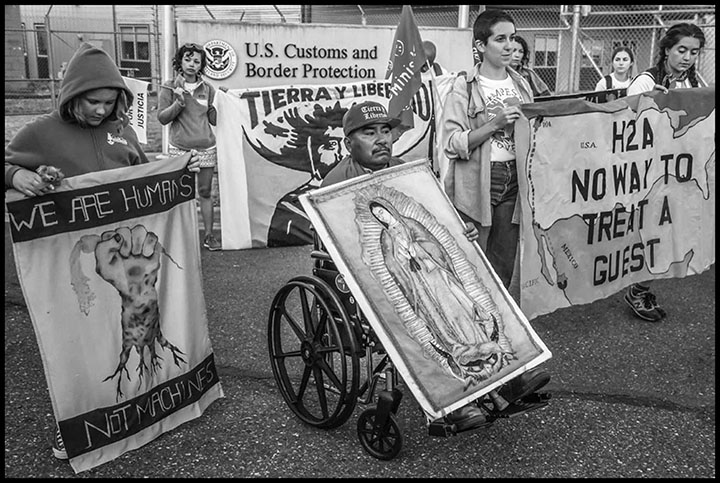
Ninety-six years ago, J.W. Guiberson, a San Joaquin Valley cotton grower, explained a primary goal of the country’s biggest agricultural interests. “The class of labor we want,” he said, “is the kind we can send home when we get through with them.”
For 22 years, during the era of the bracero program (1942-64), growers had exactly what Guiberson wanted. According to immigrant rights pioneer Bert Corona, braceros were brought from Mexico “to serve as cheap labor and to be used against the organized labor movement in the fields and the cities.” Growers brought hundreds of thousands of contract laborers from Mexico every year-until Cesar Chavez, Ernesto Galarza, Larry Itliong, Dolores Huerta, and others activists organized to halt the program at the height of the civil rights movement.
More than half a century later, however, little has changed. Not only is the bracero program not dead; President Biden wants to use its modern iteration to channel migration from Mexico, Central America, and the Caribbean. At the Summit of [some of] the Americas in Los Angeles earlier this month, Biden warned the hundreds of thousands who cross the border with Mexico every year: “We need to halt the dangerous and unlawful ways people are migrating…. Unlawful migration is not acceptable.”
Biden’s plan: “to help American farmers bring in seasonal agricultural workers from northern Central America[n] countries under the H-2A visa program to improve conditions for all workers.”
The idea, however, that this modern-day bracero program will improve conditions for workers was contradicted by Biden’s own Labor Department. In November 2021 the US Attorney in Georgia filed a case against 24 growers and labor contractors for abusing H-2A workers. The complaint included two deaths, rape, kidnapping, threatening workers with guns, and growers selling workers to each other as though they were property.
For decades the H-2A program has abused migrants, pitting them against workers in the United States in a vicious system to keep wages low and grower profits high. Its record includes several deaths. In 2007, when Santiago Rafael Cruz was sent by the Farm Labor Organizing Committee to fight corruption in H-2A recruitment in Mexico, he was tortured and murdered in his office, undoubtedly by recruiters. His murderers were never caught. In 2018 Honesto Silva, an H-2A worker, died in a Washington State field as he labored in extreme temperatures, unable to refuse a foreman’s demand that he continue working. When his coworkers protested, they were deported-the fate that hangs over all H-2A workers who assert their rights.
In a nationwide rash of Covid deaths among these euphemistically called “guest” workers, two died at the Gebbers Farm in eastern Washington last year-Juan Carlos Santiago Rincon from Mexico and Earl Edwards from Jamaica. They were victims of crowded barracks that spread the virus. Growers, however, successfully lobbied the state to continue housing workers in rooms with bunkbeds, where they were unable to socially distance.
To fend off challenges that the administration is pumping new workers into a program with a record of abuse, the administration promises “guidelines on recruitment.” These will be drafted in cooperation with Walmart, “which notes the importance of H-2A migrant workers to US agriculture and that the fair recruitment guidance aligns with the company’s own expectations around responsible recruitment. [from a White House Fact Sheet].”
In reality, enforcement of criminally weak protections for H-2A workers is virtually nonexistent. In 2019 the Department of Labor punished only 25 of the 11,000 growers and labor contractors using the program. Last year, growers were certified to bring in 317,619 H-2A workers. That is over 13 percent of the farm workforce in the United States-and a number that has doubled in just five years, and tripled in eight. In states like Georgia and Washington, this program will fill the majority of farm labor jobs in the next year or two. There is no way this program can grow at this rate without forcing from their jobs the farmworkers who already live in the US, over 90 percent of whom are immigrants themselves. In fact, a long string of legal cases documents the supposedly illegal displacement.
During the summit debates, another caravan of migrants from Central America moved through Mexico, dramatically underscoring the reality that migration is a fact of economic life, and will not soon stop. It is a legacy of colonialism, and now empire.
The North American Free Trade Agreement, for instance, allowed Archer Daniels Midland and Walmart to profit by taking over Mexico’s market in corn and other goods. Three million corn farmers in southern Mexico became displaced migrants as a result.
Political intervention reinforces this inequality. Honduran President Miguel Zelaya was ousted and flown out of the country after he proposed mild reforms, like raising the minimum wage. The United States was involved, Hondurans charged. It’s no wonder that Xiomara Castro, newly elected Honduran president and Zelaya’s wife, declined to come to Los Angeles to talk about the waves of migrants that left her country in the coup’s aftermath. Haiti’s former president Jean-Bertrand Aristide, twice elected and twice deposed (once flown out of the country in a US plane) was not in Los Angeles either. Meanwhile, this administration has put over 20,000 desperate Haitians on planes back to Haiti in forced “repatriations.” Now US economic warfare will produce even more migration from the countries excluded from the summit.
Yet thousands of immigrants, settled into communities across the United States, have become active partisans of social and economic change. We celebrate May Day now because huge immigrant marches in 2006 rescued the holiday from its Cold War deep freeze. Many unions are growing after making alliances with this immigrant worker upsurge. And when the pandemic made labor dangerous in lettuce fields and meatpacking plants, Mexican immigrants went to work despite their fears.
Displacing them now is bitter thanks. Growers argue they need H-2A recruitment because they face a shortage of farmworkers, yet resist desperately the obvious step of raising wages for families whose income currently averages less than $25,000 per year. The H-2A program’s supposed wage floor, the “Adverse Effect Wage Rate,” actually functions as a ceiling on farmworker wages. If local workers demand more, they risk replacement.
Ramon Torres, president of Washington State’s new union for farmworkers, Familias Unidas por la Justicia, asks, “Who do growers think was harvesting their fruit all those years before H2-A? They’ve displaced many local people in Yakima who used to work in the apple harvest. But their longtime workers are still here, and would come back, especially if the wages are good and there’s a union.”
The UFW said it was proud to be included in the administration plan “to improve H-2A worker protections in response to vigorous advocacy by the UFW and others,” according to president Teresa Romero. “The UFW fights for every worker, union or non-union, regardless of immigration status-including the H-2A workers currently protected by UFW contracts…. The best way to improve conditions is by covering farm workers under union contracts through bona fide unions such as the UFW, FLOC, and Familias Unidas.”
Some farmworker unions, like Familias Unidas, call for ending the H-2A program entirely, while at the same time helping workers currently on H-2A visas when they go on strike or protest bad conditions. The union won its first contract at Sakuma Farms, in part, by defeating the company’s effort to replace striking members with H-2A workers. To the UFW’s Romero, however, “there is no realistic expectation Congress will end the H-2A program. But reducing H-2A worker abuses through efforts like this pilot program will also raise standards for domestic workers.”
All farmworker unions agree that US farmworkers need higher wages and organizing rights. Today migrant pickers still sleep in cars during the grape harvest, just as they did when Depression-era photographers took pictures of migrant camps. The 1965 Delano grape strike and the organizing drives of the ’60s and ’70s started to attack that poverty. Ending the bracero program was as necessary to winning that fight as ending the H-2A program is to ending farmworker poverty today.
Mexico’s President Andres Manuel Lopez Obrador campaigned for office by promising Mexicans he’d defend their right to stay home, to not migrate. In his inaugural speech he praised the 24 million Mexicans living in the United States for sending $30 billion a year home to their families, calling them victims of failed neoliberal economic policies. “We will put aside the neoliberal hypocrisy,” he promised. “Those born poor will not be condemned to die poor…. We want migration to be optional, not mandatory, [to make Mexicans] happy where they were born, where their family members, their customs and their cultures are.”
Yet recently the Mexican government also seems to be buying the labor scarcity story. In February of 2021 President Lopez Obrador announced that he would propose a work visa program to recruit 600,000-800,000 migrants annually from Mexico and Central America to work in the US. “We can regulate and order the flow of migration, because the workforce is needed,” he said in September. While he refused to attend the summit, he will meet Biden in July, bringing with him proposals for restructuring migration from Mexico.
Evy Peña, communications director for the Centro de los Derechos de Migrantes, pointed out that AMLO’s position is contradictory. “One the one hand, he said he would push for a model based on human rights. On the other, he mentioned the bracero program,” she wrote in an editorial for Mexico’s Reforma.
If the Mexican government wants to protect the human rights of migrants, the H-2A visa program is not the solution. An H-2A visa ties migrants to their employers and employment status. Growers recruit them and send them home when the harvest is done-or if they go on strike or protest against mistreatment. Instead, migrants need visas that give them the ability to bring families and belong to the communities around them, that recognize their labor rights, and that provide the benefits their wage deductions pay for, especially Social Security. Visas with rights are much more like the normal residence visa.
Biden and Lopez Obrador both claim concern for the Mexicans already living in the United States, especially the 2 million workers whose labor makes US agriculture possible. Over half, according to the Department of Agriculture, lack legal immigration status. While comprehensive immigration reform bills, with their tortuous paths to legal status and heavy enforcement provisions, have failed repeatedly, many immigrant rights campaigners propose a simpler solution. They advocate changing the so-called “registry date,” which refers to the date of arrival in the US. Undocumented people who have arrived before this date can apply for legal status. If the current date of January 1, 1972, were advanced to the present date, all people without papers would be able to apply.
A bill to abolish the H-2A program and put in place a system providing residence visas to work-seekers, combined with changing the registry date, would need congressional action to modify the 1929 Registry Act. But Democrats still control Congress, and the proposal’s simplicity makes it a better vehicle for campaigning than an expanded bracero program.
Those who doubt its political viability might recall that the civil rights movement didn’t just end the bracero program. It won a better immigration system that didn’t funnel cheap labor to growers but instead gave immigrants residence visas, encouraged family reunification, and ended racial preferences that discriminated against immigrants of color. Ending the bracero program set the stage for the great grape strike and the creation of modern unions for farmworkers.
That solution is as valid today as it was 60 years ago.

Leave a Reply
You must be logged in to post a comment.