• Skip to primary navigation
  • Skip to main content
  • Skip to footer
WRAP

WRAP

Western Regional Advocacy Project

  • Donate Now
  • Get Email Updates
  • Contact Us
  • Home
  • About
    • 20 Years of Unhoused People Fighting for Dignity + Respect
    • 40 Years of Fighting
    • History
    • Mission
    • Strategy
    • Members
  • Campaigns
    • Business Improvement Districts
    • House Keys Not Sweeps
      • TARGETED, BANISHED, DISPLACED & SWEPT
    • Legal Defense Clinics Project
    • Homeless Bill of Rights
    • Without Housing
    • Street Outreach
  • Organizing Tools
    • Without Housing Organizing Toolkit
    • Homeless Bill of Rights Campaign Manual
    • WRAP Organizers Manual
    • WRAP Artwork
  • Resources
    • Pipe Dreams and Picket Fences Report
    • Art in Action Power Point Slide Show
    • Hobos to Street People
    • House Keys Book
    • Political Education
    • Legal Research
  • Media
    • Newsletters
    • Blog
    • Hobos to Street People Art Show
    • Street Newspapers
    • Sweeps Gallery Videos
    • Videos
  • Support Us
    • Donate
    • Become a Monthly Sustainer
    • Volunteer
    • Support WRAP
    • WRAP Newsletters & Updates Sign Up

Shooting of homeless man shows need for sincere change in SFPD

April 14, 2016 by Jonathan 1 Comment

by Lisa Marie Alatorre, Coalition on Homelessness

San Francisco – A shooting by police officers of a homeless man camping on Shotwell Street near 18th Street occurred in the Mission Thursday, April 7. On Friday, the Medical Examiner identified the victim as 45-year-old Luis Gongora, a San Francisco resident. While we do not have complete information, reports from eyewitnesses raise several red flags:

1.The victim was non-English speaking and likely did not understand police commands.

2.The man was camping in a tent on Shotwell and likely has been the victim of the numerous “sweeps” that have taken place in the general area. Division Street was the most well known, but sweeps and citing of homeless people surrounding Division have taken place regularly since.

3.The man may have been in possession of a knife, but eyewitnesses have contradicted this statement.

4.Eyewitnesses report he was lying down and not resisting when shot.
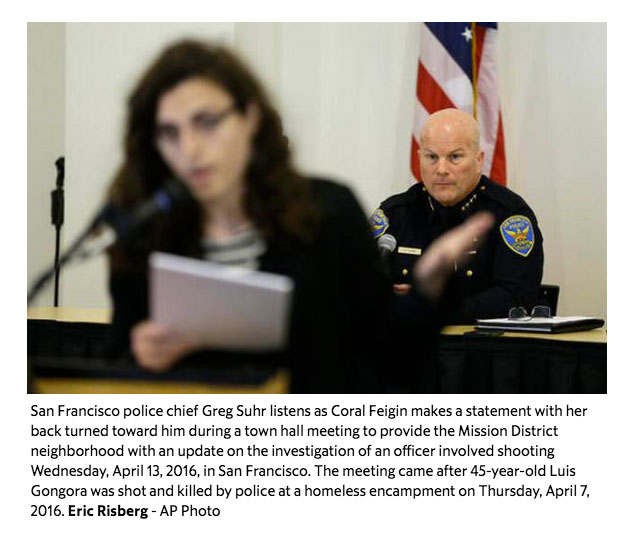
Screen-shot-2016-04-14-at-9.34.25-AMThis shooting happened less than 24 hours after a late-night Police Commission meeting at which members of the Police Officers Association (POA) fought against changes to the Department General Order (DGO) concerning use of force.

The POA has called for a policy worse than the status quo: They have pushed to bring language back two decades, before the old policy was updated. This conservatism fails to recognize the deep problems inside SFPD that have surfaced in recent years.

The only changes they recommend are additional weapons. At last night’s meeting, members of the public predicted that more police shootings would take place unless systemic change occurred.

On top of the need for language accessibility and halting the criminalization of homeless people, there were five things the Coalition on Homelessness called for in the new DGO last night:

1) Substitute language requiring “minimal” instead of “reasonable” force

In the past, many cities have sanctioned “reasonable” force by police officers. The current best practice is to push officers instead to use “minimal” force: Instead of asking herself, “Am I being reasonable right now?” an officer should be asking, “Could I safely use less force?”

This perspective has found wide acceptance even among police: The Police Executive Research Forum, in its report, “Re-Engineering Training of Police Use of Force,” recommends “minimal use of force.” Another January 2015 report, “Use of Force: Taking Policing to a Higher Standard,” states that police departments should hold themselves to a higher standard than minimum legal requirements.

Many cities have done just that and used language of “minimal force,” including New Orleans, Las Vegas, Washington, D.C., Chicago, Portland, Albuquerque, Seattle, Milwaukee and Oakland, to name just a few. San Francisco set trends in 1995 with the use of “minimal” in their general order.

We should not settle for the lowest possible bar: While valuing officer safety, we must also embrace sanctity of civilian life.

2) Make de-escalation mandatory

Throughout the DGO, use of de-escalation techniques must be mandatory. We strongly recommend that language should state that officers “shall” use verbal de-escalation when feasible and safe. The proposed language recognizes that officers must decide when de-escalation techniques are reasonable and safe: It is not an unreasonable constraint.

But saying that officers “may” employ verbal de-escalation allows officers to choose not to avoid violence. There are many cites that include “will,” “shall,” “must” instead of the lukewarm language of “should” or “may;” among these are New Orleans, Albuquerque, Chicago and Cleveland.

3) Remove electronic control weapons from the discussion

In the midst of trying to move forward as a department to address the very real issues associated with current use of force policies, SFPD decided to introduce electronic control weapons (usually known by the brand name “Tasers”) as part of that discussion. While there is broad community support for DGOs that support the sanctity of life, time and distance, and de-escalation, the introduction of an often lethal weapon is tremendously controversial, and threatens to undermine the ability of SFPD and community groups to work together.

In one of the few independent studies done on these weapons by UCSF, they found an average six-fold increase in in-custody deaths and a twofold increase in officer-involved shootings in the first year following the adoption of Tasers. In subsequent years, deaths declined, but remained higher than in the base year. Eagerness for a new weapon that has led to an increase in civilian deaths is not consistent with valuing the sanctity of human life.

4) Consider and implement the Crisis Intervention Team DGO

We need to fully operationalize the Crisis Intervention Team to prevent officer-involved shootings. This successful model has been shown to decrease critical incidents by training an elite corps of police in de-escalation techniques.

The program originated in Memphis but has been successfully replicated in dozens of cities throughout the country. CIT has only been partially implemented in San Francisco: The Department has focused on training but has been missing the operations component.

5) Ensure data collection on use of force

This is clearly needed: If we as a community want to decrease deaths from officer-involved shootings, we must have transparent information on use of force that is accessible to the public. This should be outlined in the DGO.

Lisa Marie Alatorre, human rights organizer at San Francisco’s Coalition on Homelessness, can be reached at lmalatorre@cohsf.org.


Friends of man shot by SFPD give statement from Mission Local on Vimeo.

Filed Under: Advocacy, Civil & Human Rights, Discrimination, Homelessness, Local Government, Politics, WRAP Members

Reader Interactions

Comments

  1. MPetrelis says

    April 15, 2016 at 8:28 pm

    Through a FOIA request, I’ve obtained thousands of SFPD pages about use-of-force, including names and badge numbers of cops involved and whether suspected were injured. Blogged about the info here: http://mpetrelis.blogspot.com/2016/03/da-releases-15000-pages-of-sfpd-use-of.html

    Log in to Reply

Leave a Reply Cancel reply

You must be logged in to post a comment.

Footer

Instagram Feed

The disinformation surrounding homelessness is a c The disinformation surrounding homelessness is a constructed narrative built over decades of policy changes. This narrative intentionally puts blame on individuals for experiencing homelessness instead of looking at the structural & systemic character of poverty.

Join the Western Regional Advocacy Project for a community teach in to understand the historical context and basis for the state of poverty & homelessness today! 

✨WHEN - Saturday, August 15 
✨WHERE - 518 Valencia, Eric Quezada Center 
✨WHAT - Community teach in 
✨TIME - 2:00pm 
✨Light snacks provided 

We know poverty is not simply a choice issue. Oppression is not a result of individual bad choices. There is importance in understanding why we’re in this current context of rising fascism to better organize! 

Many issues, one fight! 

Together we are stronger and the issues we are all facing have a common enemy. Let us link our organizing with one another because together is the only way through! 

The event is a part of WRAP’s annual community congress where organizers from across the west coast convene in San Francisco to share about their local organizing, exchange tactics, and strengthen the initiatives across WRAP! 

If you can’t make it to the afternoon event, WRAP is hosting a cultural night in the evening to highlight poets, musicians and artists across many struggles. Join us for a celebration of our resistance! 

Can’t make it to the teach in but still want to support the work of WRAP? 
Donate to bit.ly/wrapf2f26 where all funds raised will go towards the costs of the congress! Link can be found in our link tree.
Join WRAP on Saturday, August 15 for “Many Issues, Join WRAP on Saturday, August 15 for “Many Issues, One Fight! An evening of music, poetry, and artwork to celebrate our collective fight for dignity and respect!” 

✨WHEN - Saturday, August 15 
✨WHERE - 518 Valencia, Eric Quezada Center 
✨WHAT - Cultural night hosted by WRAP 
✨FOOD PROVIDED! 

With the intensified attacks on all of our communities; artwork remains a powerful tool to share our experiences, understand each other’s struggles, and broaden the collective fight for a better future. 
Since the passage of the Big Fascist Bill, communities in man-made vulnerable positions face even harsher hostilities from shrinking accessibility to social services to criminalization of queer and trans people to the kidnapping of our immigrant neighbors. The list goes on and on but we won’t let these fascists take away our dignity, instead we will come together and bridge our fights! 

The way through is together! 

Let us sing. 
Let us dance. 
Let us break bread. 

Let us come together to learn about each other’s struggles and share resources. The evening will also include a raffle showcasing swag from WRAP members, local artist contributions, and many more!!! 
The event is a part of WRAP’s annual community congress where organizers from across the west coast convene in San Francisco to share about their local organizing, exchange tactics, and strengthen the initiatives across WRAP! 

Can’t make it but still want to support the work of WRAP? 
Donate to bit.ly/wrapf2f26 where all funds raised will go towards the costs of the congress!
(500,000 Public Housing Units have already been lo (500,000 Public Housing Units have already been lost), and $230B in cuts to Food Stamps coupled with draconian work requirements in several programs mean more people will be living unhealthy, unhoused and hungry in the richest country in the world. Stay tune for more updates! https://bit.ly/2026nhlc
WRAP has the power of collective mobilization whil WRAP has the power of collective mobilization while remaining accountable to the realities of local communities. By bringing together some of the fiercest organizations fighting homelessness, for 21 years WRAP has developed a unique structure that combines documented street outreach, movement building, and national policy work, helping us bridge the local-national divisions that have hindered homeless organizing for the last four decades.
 #HousekeysNotSweeps #HousekeysNotHandcuffs #WeWillNotDisappear
Check out WRAP sweeps handout to learn the truth d Check out WRAP sweeps handout to learn the truth directly from the streets on the impact of sweeps! 

WRAP members continue to fight sweeps in their communities through utilizing documented street outreach to dispel stereotypes on what a “sweep” actually is. 

Sweeps fracture communities, displace people, & damage physical and mental health. 

When asked, what alternatives/services were people offered? 88% were not offered any services and 74% had all of their belongings thrown away at the sweep. Sweeps are not a solution to addressing homelessness but rather another phase in the cycle of homelessness! 

This handout is available for use! Go to bit.ly/wrapsweepszine to download. 
Learn more and connect with the nearest WRAP member and join the fight against sweeps! 

All members are tagged in the post and the list can be found on our link tree. List below:

 @coalitiononhomelessness
 @housekeysactionnetworkdenver
 @humanrighttohousingcollective
 @judismidnightdiner
 @lacanetwork_official
 @loveandjusticeinthestreets
 @unumissoula
 @streetspiritnews
Check out WRAP sweeps handout to learn the truth d Check out WRAP sweeps handout to learn the truth directly from the streets on the impact of sweeps! 

WRAP members continue to fight sweeps in their communities through utilizing documented street outreach to dispel stereotypes on what a “sweep” actually is. 

Sweeps fracture communities, displace people, & damage physical and mental health. 

When asked, what alternatives/services were people offered? 88% were not offered any services and 74% had all of their belongings thrown away at the sweep. Sweeps are not a solution to addressing homelessness but rather another phase in the cycle of homelessness! 

This handout is available for use! Go to bit.ly/wrapsweepszine to download. 
Learn more and connect with the nearest WRAP member and join the fight against sweeps! 

All members are tagged in the post and the list can be found on our link tree. List below:

 @coalitiononhomelessness
 @housekeysactionnetworkdenver
 @humanrighttohousingcollective
 @judismidnightdiner
 @lacanetwork_official
 @loveandjusticeinthestreets
 @unumissoula
 @streetspiritnews
Sweeps are a way to push people further into the m Sweeps are a way to push people further into the margins of society and out of the public eye. They are a sham response to a manufactured issue. Sweeps will never solve homelessness, instead they play into the vicious cycle of homelessness. 

Organizers keep fighting back! Our outreach to the community tells us the trends of criminalization, dehumanization, & a gap in actually moving towards viable solutions are on full display. 

Criminalization of poor and unhoused people will continue to expand so long as the reins on America’s neoliberal approach to fiscal and social policy remain untethered. 

We must seek the commonalities between our communities in order to thread the power of our organizing together! 

*Note: This is an abridged version of the full article which can be found on our blog at bit.ly/fightsweeps 

Continue to support the work of WRAP members. All members are tagged in the post and the list can be found on our link tree. List below: 

@coalitiononhomelessness
@housekeysactionnetworkdenver
@humanrighttohousingcollective
@judismidnightdiner
@lacanetwork_official
@loveandjusticeinthestreets
@unumissoula
@streetspiritnews

Donate to WRAP to support our work! Donation link can be found in our link tree!
For 21 years, we’ve worked alongside @lacanetwork_ For 21 years, we’ve worked alongside @lacanetwork_official and other local groups, with community outreach guiding all our campaigns. 

The #Right2Rest Bill was introduced in Colorado, Oregon, and California, and WRAP member groups in all three states built it together from the same outreach to our collective community. 

It lost nine times across those states. 

The point was never just the bill. The point was the movement behind it. #HousekeysNotSweeps #HousekeysNotHandcuffs #WeWillNotDisappear
As part of our 21st Anniversary Celebration, we ho As part of our 21st Anniversary Celebration, we hosted an IG Live conversation between Paul and General Dogon with @lacanetwork_official about why WRAP was created: the idea of building a broader network of community organizations down for the serious fight for dignity and respect for our communities. 

We know that our job as organizers is to connect accountable organizations and build power collectively, because that makes us all stronger, it makes us all smarter, and it gives us more skills. #WRAP21 #HousekeysNotSweeps #HousekeysNotHandcuffs
The systems are doing what they were built to do: The systems are doing what they were built to do: displace people, criminalize poverty, protect profit. WRAP + our members organize and fight for dignity and respect.

Every one of us has a role right now; If you have resources, you make space for the folks with time, skills, & energy to work that magic. Every dollar keeps us moving.

$21, $210, or $2,100...it all keeps WRAP + members in sync. Link in bio!
Follow on Instagram

Facebook Icon

Facebook Feed

[custom-facebook-feed feed=2]

Twitter Icon

Twitter Feed

[custom-twitter-feeds feed=2]

YouTube icon

Youtube Code

Our Channel

Copyright © 2026 Western Regional Advocacy Project WRAP · Log in